Hydrogeologist disputes SAWS aquifer-protection rationale as City Council votes on Guajolote Ranch MUD request
Vote timing and what the city is being asked to approve
San Antonio City Council is scheduled to vote Feb. 5 on whether to consent to the creation of a municipal utility district (MUD) tied to the Guajolote Ranch development in northwest Bexar County. The proposed subdivision has been described in public filings and public meetings as a roughly 3,000-home project on about 1,100–1,160 acres north of Grey Forest, within San Antonio’s extraterritorial jurisdiction.
A MUD is a separate governmental entity typically used to finance and manage basic infrastructure such as water, wastewater, drainage and roads. If the city grants consent, the district can generally issue bonds and levy taxes within its boundaries to pay for infrastructure. If the city denies consent, the developer may need to pursue alternative pathways for utility service and financing, potentially including further state-level regulatory steps.
The central dispute: wastewater and the Edwards Aquifer
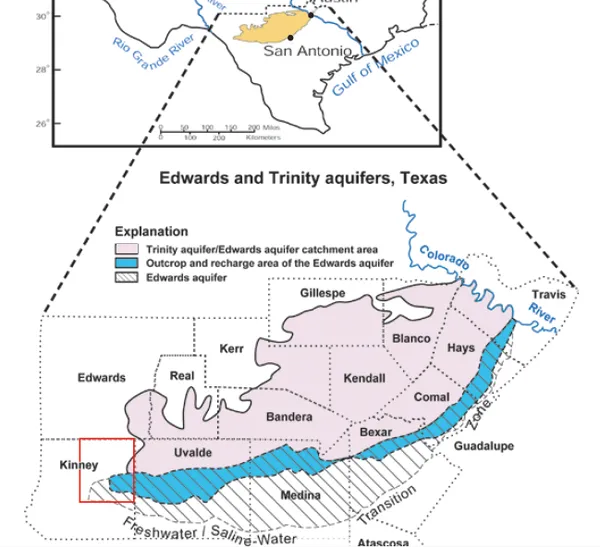
Opposition to the project has centered on a wastewater treatment plant planned to serve the development and the potential for treated effluent to reach waterways in the Helotes Creek watershed, an area connected to regional groundwater resources. The Texas Commission on Environmental Quality approved a wastewater permit for the project in October 2025, and that action has been the subject of continued legal and political challenges.
In the days before the City Council vote, hydrogeologist Dr. Ronald Green sent a letter to the mayor and council members disputing the basis of San Antonio Water System’s public assurances regarding the subsurface geology between the project area and the Edwards Aquifer. Green argued that the concept of a protective underground “layer” functioning as a barrier does not reflect how the local karst limestone system behaves.
Green’s warning focuses on fast-moving groundwater pathways typical of karst terrain, where fractures and solution channels can allow water—and contaminants—to move quickly underground.
Green also raised questions about the evidentiary foundation for the utility’s position, stating that he has not seen recent studies or data that would support a more protective interpretation of the subsurface conditions in the area under discussion.
SAWS response and negotiated conditions
SAWS has said it has conducted rigorous reviews of the underground geology and that it negotiated what it has described as unusually strict water-quality conditions as part of service-related agreements connected to the project. SAWS has also stated that water delivered to its customers will remain high quality.
Separately, a previously disclosed settlement involving the city’s Metropolitan Health District and the private operator associated with the project’s wastewater plans set operational requirements that include higher certification standards for plant operation, monitoring obligations and emergency response protocols. While such conditions are designed to reduce risk, public debate has continued over whether any discharge or failure scenario in this watershed presents an unacceptable threat given the Edwards Aquifer’s importance to regional drinking-water supplies.
What happens after the vote
If City Council approves the MUD, the district could move forward as a financing and governance mechanism for project infrastructure, subject to applicable regulatory requirements.
If City Council denies the MUD, the project’s backers may pursue other infrastructure and regulatory options, while litigation and appeals tied to the wastewater permit continue.
Regardless of the outcome, the Guajolote Ranch debate is likely to remain a high-stakes test of how San Antonio and regional regulators manage growth pressures near sensitive recharge and contributing areas tied to the Edwards Aquifer.